Your AI Initiative Can Work and Still Fail
AI can produce useful agendas, summaries, and dashboards without improving a single decision or outcome. Design the operating loop that connects information to ownership and action, tailor it to the team, and expand the automation as trust grows.
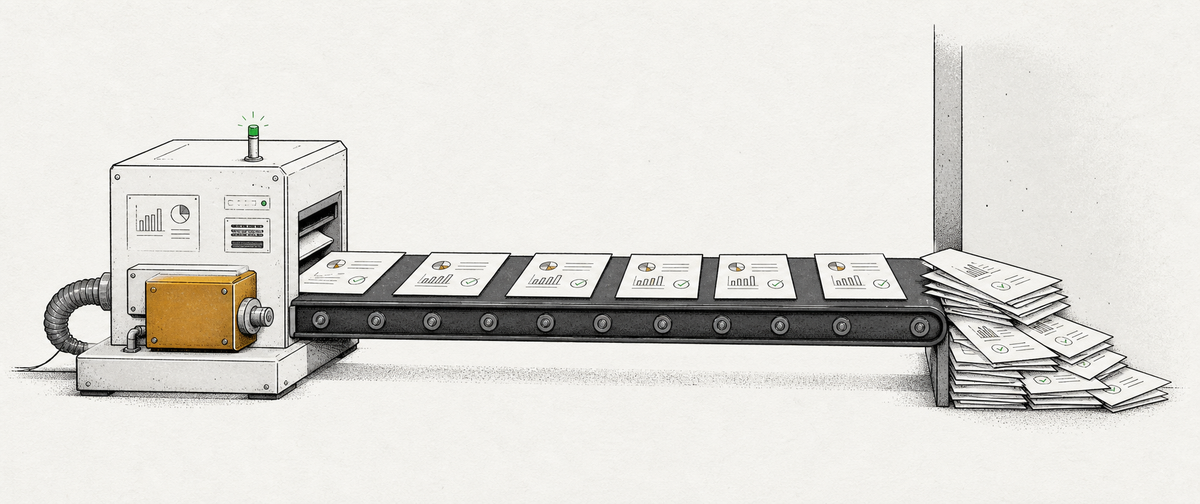
Your AI initiative can produce exactly what you asked for and still fail.
The meeting summaries arrive. The customer feedback gets categorized. The weekly report writes itself. Every workflow runs as designed but your company isn't moving faster.
That is a lot of automation without a reliable change in decisions, ownership, or outcomes.
The work was framed around producing an artifact, not improving an operation.
An artifact is a thing an AI system can produce, such as an agenda, a summary, a dashboard, a recommendation, or an action-item list. Artifacts can be useful. They can save time and make information easier to see. But an artifact by itself doesn't reliably change how an organization decides, assigns ownership, or measures outcomes.
An operating loop connects information to a decision, gives someone ownership of the next step, carries that decision into action, and checks whether the outcome improved. That is where an automation changes how the organization works. The artifact may support the loop, but it isn't the loop.
Earlier this week, while I was getting my daughter out the door for camp, I had a 10 o'clock client meeting on my mind. They'd emailed a few items they wanted to discuss. From my phone, I asked Claude to pull the relevant emails, identify the agenda items, research the issues, and create a slide for the conversation. I just wanted a visual to support our discussion.
It made me wonder what would happen if an organization generated that kind of agenda for every meeting. Assume the output is excellent. A polished agenda still doesn't guarantee that the meeting reaches a decision. It doesn't assign an owner. It doesn't make follow-through more likely. It can accelerate an existing meeting discipline, but it won't create one.
In Captain America, the super-soldier serum doesn't make you a hero. It amplifies what's already there.
AI can do something similar to an organization's way of working. If a team has a clear outcome, defined ownership, and a reliable way to follow through, AI can help that loop run faster. If those things are missing, AI can still produce a large volume of reports, software, and features.
The principle is simple. Applying it is hard. All that output provides visible evidence that something is happening, even when no decision has been made and no outcome has improved. That volume can mask the absence of direction and let an organization go much longer without confronting how little progress it has made.
What should become different?
Define the operational outcome, not the AI activity. "We will use AI to prepare meetings" describes an activity. "Our client meetings will end with a documented decision, a named owner, and a next action" describes a change in how work moves.
The distinction matters because it gives the team something to optimize for. If the agenda is generated but meetings still end without commitments, the initiative hasn't achieved its purpose. The next design question is not how to improve the prompt. It's what needs to change in the meeting itself.
The same pattern appears in software development. Around the same time, I made a version of this argument to the CTO of a media company. Software teams have spent years talking about test-driven development, code review, and repeatable delivery systems. We haven't always practiced those principles as consistently as we claim.
AI makes that distinction harder to avoid. If you have a real system for producing and validating software, AI can make that system dramatically faster. It can write the test, produce the code, run the test, inspect the failure, and try again with far less overhead.
If your development process is mostly theater and ultimately depends on trusting the person who placed the semicolons, generating more code won't fix it. You'll produce the artifact faster without strengthening the operating loop around it.
What happens after the system produces something?
Name the decision, the owner, and the expected action. If a system identifies a customer problem, who decides whether it belongs on the roadmap? If it produces a recommendation, who has the authority to act on it? If it summarizes a meeting, where does the next action live and when is it checked again?
This is where a generated agenda becomes part of an operating loop or remains a document. When someone is driving the meeting toward an outcome, the agenda can lay the foundation. The meeting still has to produce a decision, and someone has to own what follows.
AI can then synthesize the discussion, decisions, action items, and owners. That makes follow-through easier. But if the team isn't clear on where it wants to go, every one of those items can arrive in an inbox and be ignored.
How will we know the organization changed?
Measure the effect on the work, not the volume of artifacts or AI usage. Depending on the workflow, that may mean shorter cycle times, fewer dropped handoffs, higher follow-through, work removed from a team's week, or a better business outcome.
An organization can have hundreds of AI-generated agendas and no evidence that its meetings improved. It can have a smaller number of automations that remove a bottleneck, clarify a decision, and change the speed or quality of execution. The second result is the one that matters.
How should the system grow?
The system has to be tailored to how the team works. Teams make decisions, assign ownership, and follow through differently. Even a summary has to reflect what the team cares about, what it can ignore, who needs the information, and what should happen next.
Trust in automation grows slowly. Drop an end-to-end system into a team's lap and one imperfect step can discredit the whole thing. Start smaller. Automate one useful part of the loop, let the team inspect the output, improve it with them, and expand as the system earns their confidence.
This is not an argument for waiting until every cultural issue is resolved before using AI. A capable transformation partner can help reveal where work is getting stuck and redesign the loop with the people who run it. But leadership still has to participate. They need to identify the pain, expose how work actually happens, decide what should change, and commit to acting on what the system reveals.
The artifact, the operating loop, and the team's trust in both have to develop together.
That is a useful test when evaluating a partner as well. Look for someone who can ask about decisions, ownership, and outcomes alongside models, prompts, and integrations. Automating the visible artifact is often the easy part. The harder and more valuable work is diagnosing the operation around it.
AI can make information easier to collect, interpret, and distribute. It cannot make an organization act on information it has not designed itself to use. The first step is understanding how information becomes action. Once that operating loop is visible, you can decide where AI belongs. Without it, better automation may only produce more evidence that nothing has changed.