I'm Going to Have to Say Goodbye to Granola
After years with Granola, I'm assembling a replacement around my own workflow. That personal decision reflects a larger shift in software as AI makes bespoke tools practical and changes what makes a software business defensible.
I've used Granola for years. That's hundreds of meetings transcribed since July 2024. I started using it before Cursor, and long before Claude Code became the place where I spend most of my working day.
That's an unusually long run for a piece of AI software. Most of the tools I've tried over the past few years have disappeared from my workflow almost as quickly as they entered it. Granola stayed. It has been quiet, reliable, and persistently useful.
But I'm going to have to say goodbye to it.
I've been a free rider for most of that time, so this isn't a complaint about Granola owing me something. It doesn't. My problem is that I've never wanted most of the product Granola is becoming.
I wanted it to notice when a meeting was starting, prompt me to record, and produce a transcript. Then I wanted that transcript to leave Granola.
I rarely share Granola's notes with other people. I don't rely on its summaries. I understand the value of building an organizational knowledge system from every meeting a company records, but I don't have an organization that works that way. My knowledge system is in Obsidian. Granola was an excellent recording layer for it.
For a long time, an Obsidian plugin made that arrangement work. It copied my Granola transcripts into my vault automatically. From there, my own sync process could route decisions and context into project and contact files. My daily briefing could surface what needed my attention.
That connection has now broken on macOS. According to the developer of the Granola Sync plugin, Granola 7.427.0 moved the encryption key the plugin depended on into a Keychain item that only Granola can access. The developer has deprecated the plugin and says there is no workaround.
A newer plugin, Granola API Sync, would let me preserve almost the same workflow through Granola's official API on a paid plan. I'll pay for a month to export the recent transcripts I'm missing and to offer a small thank you. Then I have to decide whether I want to keep paying for the larger product. Granola is good, but the product it's becoming isn't for me.
The first instinct is to build it
Am I about to rebuild Granola?
I could.
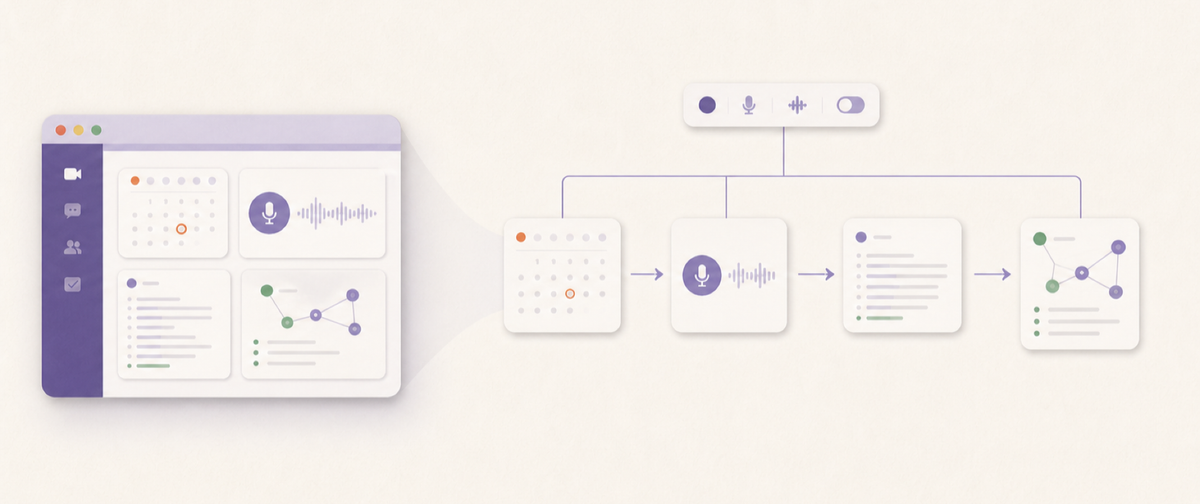
There are already plenty of tools that record meetings and transcribe them with local models. I could assemble a narrower version that watches my calendar, nudges me at the start of a call, records the audio, creates a transcript, and saves it directly into the right place in my vault.
It wouldn't be as elegant as Granola. I can tolerate rough edges in software built only for me.
Building a Mac app used to require skills few people had. AI has made those skills less scarce. The harder part of a commercial product is making it legible to strangers. Software I build for myself can skip onboarding, broad workflow compatibility, a support operation, a pricing page, and a convincing empty state. I built it, so I know how it works. It can be awkward and still fit me better than a polished product built for thousands of people.
Granola is a far better product than anything I'm likely to assemble over a weekend. Even a crude replacement could fit my particular workflow better.
Most of the machinery already exists.
Tom Elliot, the developer of the Granola Sync plugin I relied on, is now building All Ears. I'm excited about it because it follows the Unix philosophy. Instead of recreating Granola as one application, it separates capture, transcription, cleanup, and summarization into small command-line tools that work together through plain files. The recordings and transcripts stay local, and each piece can be scripted, replaced, or extended independently.
That's much closer to what I want. All Ears can handle the machinery. I'm considering a menu bar app that lets me see what it's recording and start or stop a meeting without opening the command line. That small interface is the only piece my workflow is missing.
The economics changed
Granola's decision makes economic sense. The official API gives paying customers a stable way to access their transcripts while ending the unsupported route I used for free.
Granola has a great product experience, but it isn't building for me. It wants to turn a company's accumulated meetings into organizational knowledge. I don't want Granola, or anyone else, to manage that knowledge for me. I want the raw transcript in a system I can shape myself.
That mismatch has been apparent for a while. Granola's early integrations exported summaries rather than transcripts. It took much longer to let users export the underlying conversation. The product treated the generated note as the useful object. I always thought the useful object was the transcript.
Freemium software depended on the incremental cost of serving another user being nearly zero, with some of those users eventually paying. AI changes that calculation. Every additional user can create ongoing transcription and model costs. The most enthusiastic free users can also be the most expensive ones.
I was exactly that kind of user. I recorded plenty of meetings, paid nothing, ignored the parts of the product that might have made me valuable to Granola, and extracted the useful output into another system.
Charging for reliable API access addresses one part of the economics. Granola's larger opportunity is the growing archive of meetings inside the product. Each new meeting could help it understand how a team works, connect decisions across conversations, preserve organizational context, and make every previous recording more useful.
The software alone isn't the moat. Data can become a sustainable advantage when using a product makes the product better. Granola could learn how I work with different people and turn the archive into something more valuable than its individual transcripts. It hasn't made that accumulated context useful enough to keep me inside the product. The archive matters to me because of what I can do with it in the system I've built elsewhere.
My transcripts are valuable raw material. I want a reliable way to keep putting them into my own system.
A smaller product for a smaller niche
Granola has to make software for many kinds of people. Some want polished notes they can send after a call. Some want a searchable memory for an entire company. Some want templates for sales calls or recruiting interviews. I want a transcript deposited into an opinionated folder structure in Obsidian, ready for the rest of my system to process.
Granola has little reason to prioritize a need that specific. A general-purpose application has to serve enough people to support the expense of designing, distributing, and maintaining it. I can assemble something around my own habits.
I'm unusually willing to build and maintain my own tools. Most Granola users won't follow me. They don't want to debug a recording system after a macOS update or decide which local transcription model to run. Granola's craft and convenience remain valuable.
A horizontal product now competes with rough systems built for audiences of one. Free users have always left when asked to pay. Some of them can now assemble a replacement shaped around needs that would never have supported a commercial product.
Maintaining my own system may still prove more trouble than paying for Granola. I doubt it. AI is evolving quickly, and following that change is already part of both my work and my personal life. That puts me in a position to get outsized value from the time I invest.
I'll miss the product that stayed in my workflow longer than almost any other AI tool. It worked so reliably that I didn't have to think about the machinery between a meeting on my calendar and a transcript in my vault.
Now I'm going to start with All Ears and decide whether to build the small interface I need on top. It will be less beautiful than Granola, more fragile, better suited to my workflow, and much more mine.