Cutting Headcount Is Not an AI Strategy
AI can cut company costs. That's useful, but it's the thinnest application of the technology. Strategy begins when leaders redesign products, workflows, and decisions around what AI now makes possible.
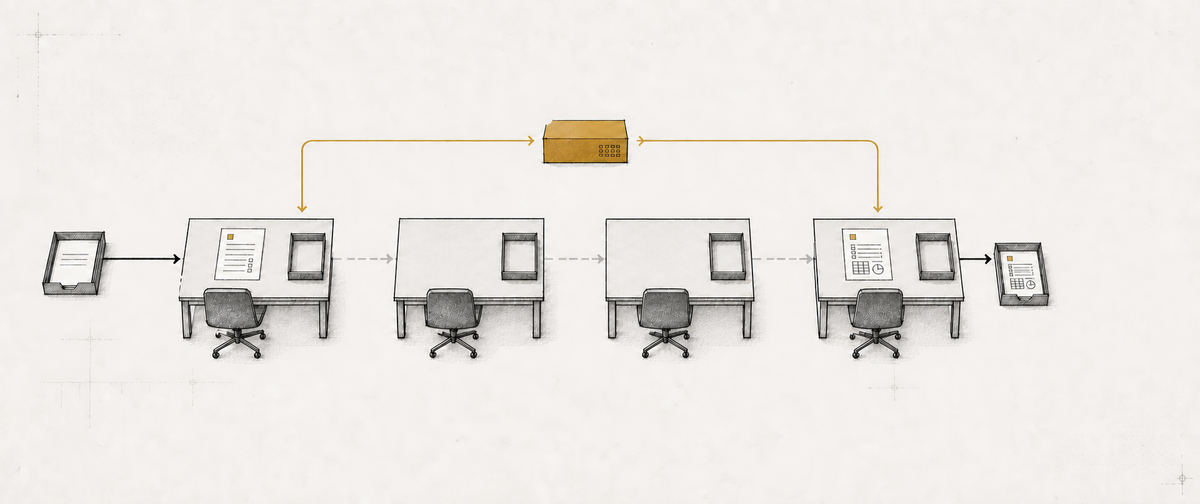
AI can reduce the labor required to read, summarize, reconcile, route, and draft information. A team that once needed people to move information between documents and systems may need fewer of them. Leaders have a responsibility to understand that opportunity, especially in businesses with thin margins or heavy administrative costs.
But reducing the labor required by the current operating model isn't the same as having an AI strategy. It assumes the company should continue to work roughly as it does today, only with fewer people inside the existing process.
That's a reasonable first phase. It only scratches the surface of what is already possible.
Efficiency starts with the company you already have
The near-term work is straightforward. Find a costly workflow. Write down how it operates. Identify the steps spent reading, extracting, comparing, and moving information. Automate what can be handled reliably. Define the cases that still need human judgment. Measure the resulting cost and quality per completed outcome.
A lot of my consulting engagements start here. This work produces savings now, teaches the organization how the technology behaves, and exposes processes that were never documented as clearly as leaders assumed.
It can also consume the entire AI agenda.
Once every initiative is evaluated by how many tasks AI can take over, teams optimize around the present structure. They automate steps inside solutions that were designed before AI existed.
We tend to meet a new technology by rebuilding the world that preceded it.
Early commercial websites borrowed from magazines and brochures. They were largely flat and informational. It took longer for builders and audiences to understand that the web could support applications, transactions, and entirely new kinds of products.
Mobile followed the same pattern. We began by shrinking websites to fit smaller screens. The more consequential products emerged once we treated the phone as a personal computer that was always connected, always with us, and equipped with a camera and GPS.
AI is at a similar stage. We are using it to produce the emails, proposals, presentations, and product requirements documents that organizations already know how to produce. Those are useful applications, but they still assume that the documents, handoffs, and workflows around them should continue to exist.
We don't yet know what the mature forms of AI-native products and companies will look like. Customers, employees, regulations, and business models will need time to adjust. But leaders can't wait for the destination to become obvious. They have to improve the business that exists while continuing to test what this new capability makes possible.
Redesign begins with the outcome
An AI-native company starts from first principles. It reconsiders what the workflow, the team, and the company are trying to accomplish. It then asks how it would produce that outcome today if AI were a foundational assumption rather than a capability added later.
That means working forward from the customer's need, not backward from the company's current structure. Which decisions still require human judgment? What information should be available when those decisions are made? What can the system search, interpret, generate, or coordinate on its own? Which steps, documents, and handoffs would never be created?
An AI-native design changes where people work. Humans may move toward setting policy, handling ambiguous cases, evaluating system behavior, and making decisions where the stakes require accountability. Machines may take on more of the searching, matching, synthesis, and coordination between those decisions. Some steps disappear because they existed only to move information between people who couldn't otherwise share context. The product, operating model, and data requirements change along with the staffing.
Run the two efforts together
Leaders don't need to choose between near-term efficiency and long-term redesign. They need to, as always, make sure the urgent doesn't overwhelm the strategic.
The efficiency portfolio should be tied to current operating metrics. How much does this workflow cost per completed task? What percentage can the system handle reliably? Which cases escalate, and what does that remaining human work cost? Those projects should have measurable impact.
The redesign portfolio should begin with a small number of important outcomes. If we created this service today, which steps would never exist? What information would the system need at the moment of decision? Where is human judgment genuinely valuable? Which data or commercial relationships would make a different product possible?
Those questions should produce experiments, not a transformation deck. A company can test a new customer journey or an end-to-end decision flow while it continues improving the current business.
At this point in the technology cycle, redesign can't be a one-time exercise. AI capabilities and costs are still changing quickly. Work that couldn't be automated reliably yesterday may become viable tomorrow after a model or tooling improvement. Companies don't need to chase every release, but experimentation and recalibration need to become part of their operating process.
The two portfolios also inform each other. Efficiency work reveals the exceptions, policies, and data gaps hidden inside current operations. Redesign work shows which of those constraints are essential and which are artifacts of the way the company grew.
The strategic test
Headcount reduction is straightforward in a financial model. Company redesign isn't. It crosses business units, challenges established incentives, and may require new data or capabilities before the economics are obvious.
If every AI initiative leaves the product, workflow, and decision structure intact, the company is applying a new tool to an old design. Headcount reduction is the thinnest application of AI because it changes the cost of the existing company without reconsidering what the company should become. It may make the company leaner. But it isn't a substitute for deciding what the technology now makes possible.