The Workflow Breakthrough I Had to Delete
Companies are building workflows around what today’s AI can’t do. As the technology improves, those workarounds can preserve unnecessary labor and keep better models working like the ones they replaced. A notification hook I depended on showed me how useful scaffolding becomes a constraint.
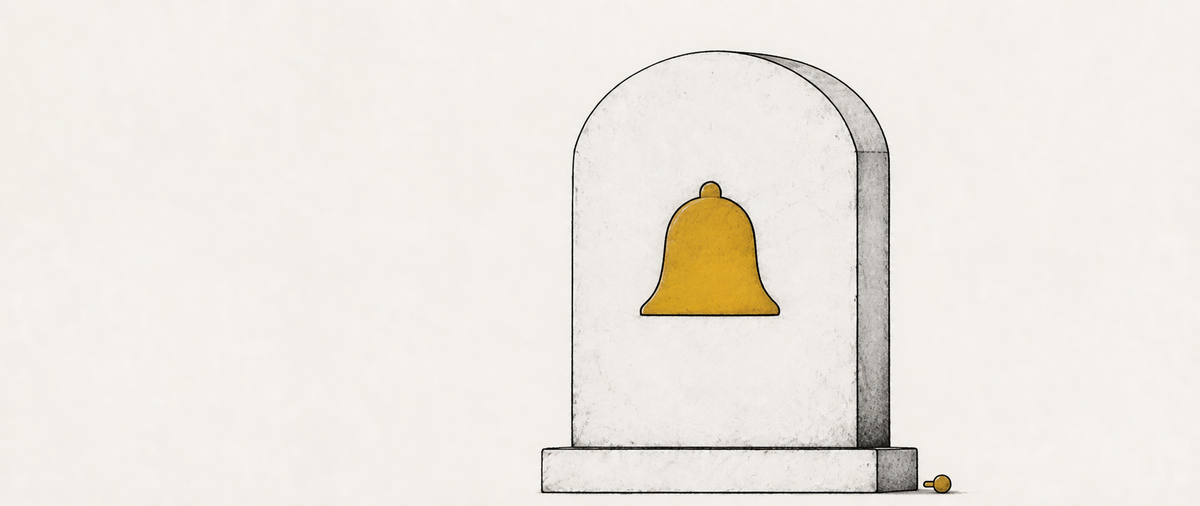
I deleted one of the best improvements I'd made to my Claude Code workflow.
It was a hook that played a sound whenever Claude finished a task and needed my attention. It was a small thing. I asked Claude to build it, added the hook, and it transformed my workflow.
Before the hook, I would keep checking the terminal to see whether Claude had finished. Sometimes I watched it work. Sometimes I moved to something else, forgot about the session, and left it waiting for me. Either way, I was managing the tool's state in my head.
The sound fixed that. I could give Claude a task, put it down, and give my full attention to something else. I trusted the sound to call me back when I was needed.
But slowly my workflow changed.
I started running several sessions in parallel. Some were doing independent pieces of work. Some were coordinating their own subagents. A session becoming idle no longer meant that the work had reached me. It might mean that one part of a larger process had finished while another part continued. I'd hear the sound go off and not be able to figure out where it came from. I couldn't trust it.
What had once saved me from watching one terminal now pulled my attention toward every internal transition across several of them. I had designed the notification for a workflow in which I was the orchestrator. It became noise once some of that orchestration moved into the system.
I killed that glorious beep a few days ago.
Useful scaffolding can outlive the problem
If the workaround succeeds, it becomes part of how you work. Eventually, you stop experiencing it as a workaround at all. It is simply the workflow.
That makes it easy to miss when the limitation it addressed disappears. A workflow built around an old constraint can keep running even as the model, the tools, and the person using them change.
My notification was doing exactly what I had asked it to do. The goalposts had moved.
Faster models require more workflow maintenance
The speed of progress in AI creates a strange maintenance burden. Software usually trains us to preserve the systems that work. With AI, a working system may need to be reconsidered precisely because the technology underneath it improved.
That doesn't mean rebuilding everything whenever a new model appears. Most new features don't deserve an immediate place in how I work.
There aren't always warning signs when a workflow becomes obsolete. The process may still work exactly as designed. We have to keep examining how we work, what outcome we want, and whether each part of the process still helps us get there.
That examination can be uncomfortable. It may tell us to change or remove something that has rescued the workflow more than once. But the technology is changing too quickly for us to treat a functioning process as a finished one. The notification I deleted was not a failed experiment. It was a successful one whose useful life had ended.
I don't rebuild my workflow for every model release. But I do revisit the parts I built to compensate for limitations the new model may no longer have.
The workflow has to keep moving
The tools I use now can take on more work, for longer, across more parallel paths than they could when I built many of my habits around them. That changes my job.
I used to supervise individual sessions and wait for each one to finish. Now I don't count the sessions in play. I need to know when the work has reached a decision only I can make, not every time one part of the system becomes idle.
I haven't built that replacement yet. Deleting the old hook was enough to expose what the new one should do.
Our AI workflows can't be treated as finished infrastructure. They encode assumptions about what the technology can do, what still requires us, and how work moves between the two. Those assumptions are changing quickly.
Sometimes keeping up means adding a new tool. Sometimes it means deleting the thing that once made the whole workflow possible.