AI is bigger than vibe coding
Coding tools are the best AI interfaces we have. Their overlooked value isn't just building software, but handling messy work at the moment of need.
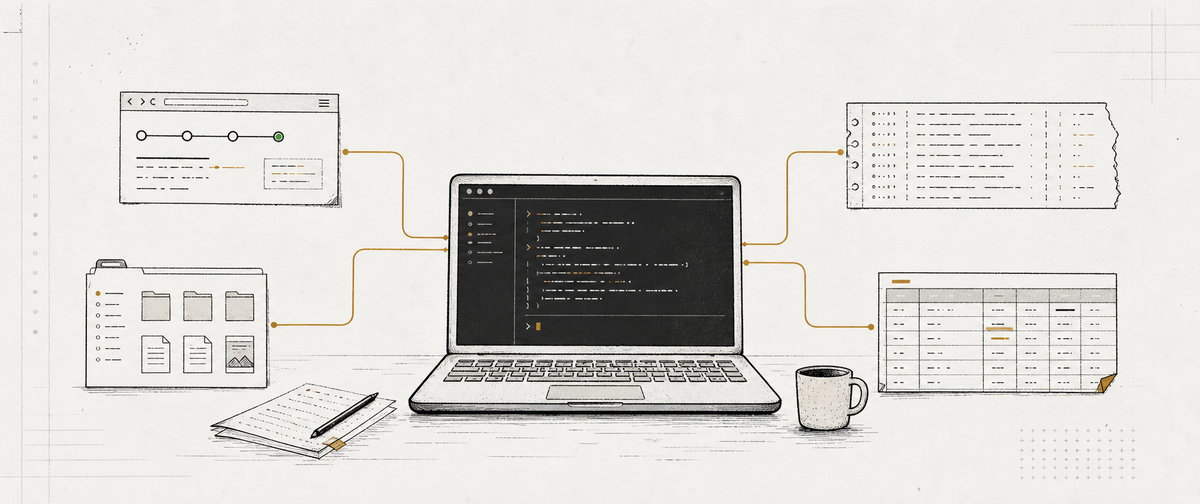
Most of the attention around AI still centers on building software.
I understand why. Vibe coding became the first mainstream proof point for what these models can do. The coding harnesses are also the best AI interfaces we have right now. They handle context well. They can use tools. They can inspect files, run commands, keep track of state, and do useful work across a messy environment.
That is a huge deal.
There is also a separate conversation about agents and automation. Most people already understand that AI can sit in the background, trigger on events, and run workflows without a person touching every step. That is the durable version. Someone builds it, it runs on its own, and it sticks around.
The pattern I want to talk about is the opposite. You start it by hand, for one task, and it goes away when the task is done. You ask the model to inspect the folder, check the logs, poll the URL, reconcile the spreadsheet, or prepare the handoff. Nobody built a product. Nothing was left running.
It is automation at the moment of need.
The software focus is leading people to a too-narrow conclusion. They see Claude Code, Cursor, Codex, and tools like them as software-building environments. They are that. They are also something larger, especially for people who don't think of themselves as software builders.
They are general-purpose work environments for tasks that live in files, websites, logs, APIs, documents, spreadsheets, and directories.
This is easy to miss if a chatbot is your reference point. A chat window can talk about your files. These tools can open them, run commands against them, poll a URL, and check the result. The difference is whether the model can reach the actual material and act on it.
I spend my workdays in these tools whether or not I am building software. The last few days gave me three mundane examples.
The first was tiny. I had a package coming and wanted to know when it arrived. The carrier gave me a URL with delivery status. I pasted it into Claude Code and asked it to keep tabs on the package and tell me when it had been delivered. It alerted me on my phone via the Claude iOS app.
I didn't build a package tracking app. I could have, but that would have been overkill. I don't need a dedicated application for one package on one carrier on one day.
What I needed was an adequate model inside a tool-rich environment. It could inspect the URL, understand the structure, poll the status, and notify me when the state changed.
That is enough.
The second example was larger. I have been helping a family business with a website project. The client handed over a directory full of content, including text, images, videos, spreadsheets, bios, logos, and assorted source material.
Historically, reviewing that would have been a grind. Someone would need to open every folder, inspect the images, check whether the videos had preview stills, match spreadsheet rows to site sections, identify missing bios, find broken or corrupted assets, and turn all of that into a useful request list for the client.
That isn't hard in the intellectual sense. It is hard because it is tedious, fragmented, and easy to get wrong.
I pointed Claude Code at the directory and at the site structure. It reviewed the material, identified gaps, found corrupted files, noticed where metadata was missing, and helped me turn the findings into a clear handoff document.
Again, no app needed. Building software for this would have been more work than the task deserved.
The value was that the model walked through a messy pile of real-world inputs, made sense of it, and created a client-ready artifact.
The third example came from client work. A company I advise had an unexpected surge in usage across part of their infrastructure. I asked Claude Code to inspect the logs, compare the behavior against the code, and help diagnose what had changed.
That investigation surfaced two separate issues. Someone on the team had rotated API keys, which broke some services for a couple of days. Claude Code then checked whether anything had tried to reach the affected services during that window, so we knew what had actually broken and what to follow up on.
It also traced the surge in usage to inefficient queries in one part of the application.
That work sits somewhere between operations, support, product, and engineering. It required code context, log access, judgment, and a willingness to follow the trail. It didn't require building a new product.
The current AI conversation often treats software creation as the main event. For some people, it is. If you can build internal tools, automate workflows, and create software that used to require a full engineering team, that matters enormously.
But a much larger group doesn't need to become software developers. The opportunity is learning when the model plus the harness is already the product.
You can point it at a folder and ask what is missing.
You can point it at logs and ask what broke.
You can point it at a spreadsheet and ask what doesn't reconcile.
You can point it at a web page, an API response, a PDF, a transcript, a CRM export, or a pile of images and ask it to make sense of the thing in front of you.
The boundary isn't "can I build an app for this?"
I don't answer that up front anymore. I throw the untidy task at the model and watch how it responds. That tells me what the thing actually is. Sometimes it is the whole job, done in one pass. Sometimes it is worth saving as a command I can run again. And sometimes it turns out to repeat the same way every time, and real software finally makes sense.
But I don't know which one it is until I have thrown the messy version at it once. So much of this work was never worth building software for, because it happens once or happens again with entirely different inputs. It just needed me to ask.
The harness may be enough.
That is a very different relationship to computing. A lot of business work has been trapped between two bad options. Either do it manually, or wait until someone can justify building software around it.
We now have a middle path.
You can ask for help with the specific task, in the specific context, without first turning it into a durable product. Sometimes the right answer is a script. Sometimes it is a document. Sometimes it is a checklist. Sometimes it is just an answer after the model has inspected the evidence.
This matters most for people outside software.
If you are in finance, operations, marketing, recruiting, legal, customer support, research, or management, a lot of your work is made of digital legwork. You pull from one source, check against another, find the missing thing, summarize the weird edge case, prepare the handoff, and notice the broken assumption.
That work used to be expensive because of the time and diligence it took.
Now, a surprising amount of it can be delegated, not by building an application, but by giving an AI system enough context and enough tools to operate.
Vibe coding is real. Building software with AI is powerful. The coding environments are good because they are the best containers we have found so far for context, tools, and action.
But don't let the software frame limit your imagination.
AI can now work directly on the messy material of your day.
That is where a lot of the value is hiding.