Jobs Are Fake
Your org chart still assumes marketing handles these things, engineering handles those. That mapping is from before. The lanes were always capacity, not rules. That capacity has come off, and the org charts haven't caught up.
I run a one-man shop. The amount of work I could ship in any given week has decoupled from the hours I have. There's no shortage of things I could be doing. The bottleneck is whether I pick the next one up. And how deep I go. The constraint for anyone working with AI isn't tooling. It isn't skill coverage. It's how far you decide to take it.
The wrinkle for a solo operator is that I don't have role lines to cross. I have to cross all of them by definition, or the work doesn't happen. I do all the jobs. What's changed in the last eighteen months is the scope of what's actually tractable for one person. I have a marketing function now. Brand consistency across image posts, the website, and the newsletter. Automated invoicing and client reports. Reengagement emails with timely news. None of these would have been part of my business three years ago. They would have required hires, contractors, or just not happened, because doing them halfway is worse than not at all. They happen now because one person can hold all of them at low enough effort to streamline the work and let me show up more professionally. I did make one "hire." An accounts receivable email address with an AI agent to sock puppet it, so I'm not the bad guy chasing invoices.
I see this with my clients. The people reshaping their organizations are the ones with high agency. They're focused on outcomes, not job descriptions. They were constrained by hours and capability for most of their careers. Both constraints loosened recently.
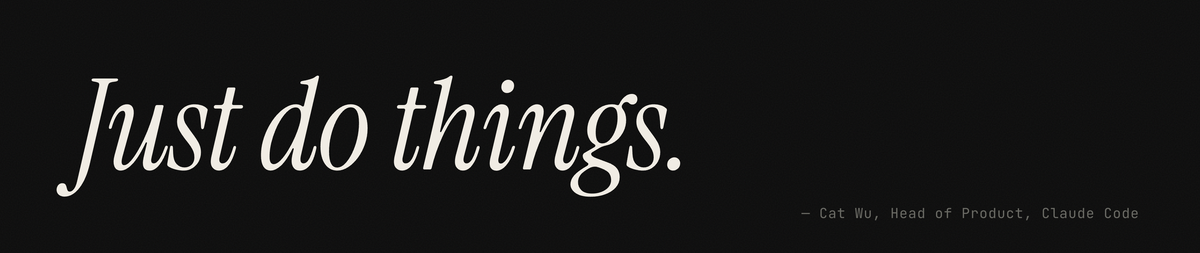
Cat Wu, Head of Product for Claude Code, named it on Lenny's podcast recently.
"Just do things. Jobs are fake." — Cat Wu, Head of Product, Claude Code
Paired with her other line, "2024 was chat, Claude Code is action," it describes an operating model. The one I run on by default. The one I keep watching the highest-leverage people at my clients adopt. The velocity story from her interview (six-month timelines compressed to a week, tools shipping tools, two-page PRDs) is the headline grabber. The buried line at the eighty-minute mark is the actual point.
Tools gated jobs
Since I started my career, jobs were tool assignments.
Engineers had code tools. Designers had Figma. PMs had spreadsheets and a calendar invite. Marketers had a campaign platform. Sales had a CRM. The job title told you which software you'd open in the morning, and the boundary between functions was mostly the boundary between tool stacks. You weren't forbidden from other tools but you didn't have the capacity.
For many people, the job was a shorthand for the tasks you did and the tools you used. The tools were complicated enough that mastering one was a career, and the output was valuable enough that companies paid specialists to wield them.
Agents end that.
Tools went universal
Cat describes engineers at Anthropic going from a Twitter complaint to a shipped feature in a week with almost no PM involvement. Her designers came up through frontend engineering, because the gap between "design" and "implementation" shrinks to nothing when the implementation is a Claude Code session. A sales engineer she cites built an app over a weekend that pulls Salesforce and Gong context and produces a customer-tailored deck in seconds, replacing a 20 to 30 minute ritual.
One operator. Multiple tools. Whatever goal is in front of them.
The interview makes it sound like an Anthropic quirk. It isn't. It's the early version of what happens everywhere once the cockpit gets cheap enough.
I've been circling this for a year
I keep writing the same post at different angles.
In Tools My Tools Can Use last September, the frame was software choice. "The divide isn't between coders and non-coders anymore. It's between those working with AI-orchestrated tools and those still clicking through dashboards."
In Your Team Has the Tools. But Nothing Has Changed. in March, the frame was organizational. "You stop managing individual steps and start focusing on outcomes. The organization isn't using AI. It's running on it."
For months I've been calling Claude Code my cockpit for all work. Document creation, code, design, meeting synthesis, client deliverables. One surface for whatever I'm trying to get done. Holding that range on my own is a deliberate stress-test of what these tools actually make possible.
Cat's line is the cleanest version. Tools gated jobs. Tools went universal. Jobs dissolve into goals.
And a dance video if it moves the numbers
The test of whether you actually believe this is what you do when the task in front of you is outside your title.
If the goal is moving a number and a 15-second video moves it, the person who ships the video wins, regardless of what their LinkedIn says. If the goal is answering a customer question and a weekend-built custom app answers it better than the CRM you pay for, the person who builds the app wins, regardless of whether they "code." If the goal is closing a deal and a pre-meeting dossier pulled from CRM, Gong, email and calendar gets you there, the person who builds the dossier wins, regardless of whether they're in sales ops.
AI isn't making everyone a coder. It's making functional boundaries irrelevant once you're clear on the goal.
Your org chart is from before
Anthropic sees it first because they build the tools that enable it. Most of the economy is eighteen months behind at best. The org charts, the role definitions, the incentive structures still assume the old mapping. Marketing handles these things, engineering handles those, design owns this, ops owns that.
If you run a team, the question isn't "which AI tool should we buy." It's whether your people act across role lines when the goal in front of them calls for it. If they don't, your adoption is going to feel hollow even after you've bought the licenses. Nobody has to forbid it. The old lanes were capacity, not rules. You stuck to your knitting because that was all you could reasonably own in a day. That constraint is gone, and most people haven't fully registered it. Part of your job is nudging them until they see the frame has changed.
"Just do things. Jobs are fake." Know what you're trying to accomplish. Pick up whatever tool solves it. Move.
Some truths just get truer as time passes. The people who internalize this are going to have a breakout year. The ones still waiting for their company to hand them a ticket are going to have a hard one.