Jev took AI in a direction I wasn't expecting
Staying current with AI pays off when you can test a new model against real work and get it into a live trial over a weekend. That's what I did with Jev in a client's email workflow, at about a quarter of the cost per call.

AI is moving at breakneck speed, and I spend a lot of time trying to keep up. I thought I'd gotten used to that pace to the extent one can, but still I was surprised by this change in direction.
When I want better results from an AI workflow, some familiar options are to use a more capable reasoning model or add review passes by other models. Those can improve the result, but they also mean more time and more tokens. I'd come to expect a lot of progress through increasingly capable models doing more work.
Then TypeSafe introduced Jev on September 15, a model specialized in making decisions that software can use directly. Seeing how much faster and cheaper that specialization could make those decisions surprised me.
Decisions inside software
You give Jev information and questions with defined answer types. It can pick from a list, score something against a rubric, or return a probability that a statement is true. It doesn't generate prose.
Existing language models can already return structured answers that software can use. Jev is built specifically for those decisions. It can evaluate several independent questions about the same input in parallel, then let ordinary code combine the answers and decide what happens next. And it does it FAST.
In TypeSafe's workflow tests, Jev roughly matched Terra and Sonnet 5's scores and ran about 25× faster than Terra. An independent routing and security benchmark put it broadly alongside GPT-5.4 Nano and Claude Haiku 4.5, with Jev the fastest and cheapest model tested. The comparison depends on the task.
Update, September 23. The day this went out, Anthropic launched Claude Opus 5.5 and OpenAI launched GPT-6 Sol and GPT-6 Luna, so I've added them to the chart. Luna cut its input price in half, to $0.10 per million tokens, and Opus dropped from $5 to $4. Jev still costs less than all three. Nobody has published a test of the new models against Jev on decision tasks yet. I also added a note that the chart compares input prices only. Jev doesn't charge for output and the others do, so each of their dots is the most optimistic version of its cost.
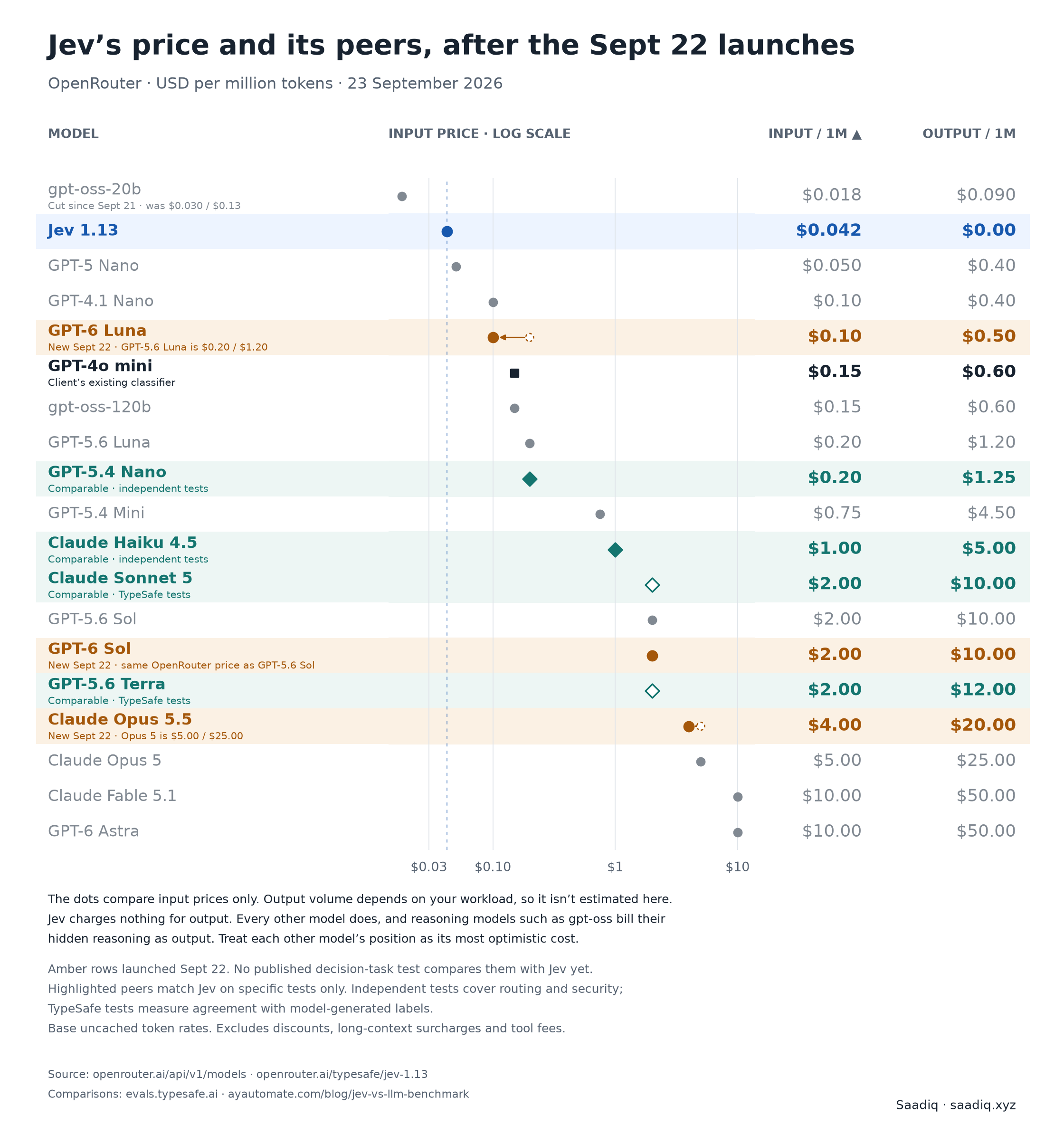
OpenRouter prices as of September 23, 2026. Amber rows launched September 22. Highlighted peers have comparable results on specific tasks.
Raksha T's collection of Jev examples opens with a demo from designer Stefan. A pile of emoji objects sits at the bottom of the screen. Type “things you can wear” and clothing and accessories rise out of the pile. Type “starting a band” and musical instruments appear. It's playful, but having to wait several seconds after each change would make it a very different experience.
when a designer gets access to Jev pic.twitter.com/FlJMeMNTJd
— Stefan (@heystefan_) September 19, 2026
A model can be capable of making a decision and still take too long for the application you want to build. Specializing in these decisions makes room for interactions where the user can keep moving. And when each decision costs less, you can afford to make more of them. I find that delightful.
From release to a live trial in a weekend
I had a client workflow where I could try this. It uses GPT-4o mini to read incoming emails and decide whether to forward them to the client's customers. The original automation replaced a task that used to take hours of her offshore team's time.
TypeSafe has shipped a skill for Claude Code, Codex, and other coding agents. It gives the agent instructions for working with Jev, and you can ask it to look through an existing project for places the model might fit. It's a little surreal how easy that skill and the coding agents make this experimentation.
Over a weekend, I tried the new model in that workflow, used historical messages to evaluate its decisions, adjusted the rules, and deployed it in shadow mode. The latest replay covered 599 messages. Looking at disagreements gave me specific cases to inspect, including mixed emails where a request for human review made sense. Jev now evaluates live emails alongside GPT-4o mini so I can compare their decisions while the existing workflow still controls forwarding.
The per-model figures in the cost dashboard put Jev at about a quarter of GPT-4o mini's cost per call. This workflow was already inexpensive compared with the team's time, so the dollar saving is small. But I could put a new release to work and measure the difference within days of hearing about it.
Staying current has a practical payoff right now. The coding tools make it easier to try a new approach. Historical data and a way to score the results help me decide whether it's worth keeping. The technology is surprising me, and it's getting easier to do something useful with that surprise.