First look at Claude Design: the grind goes away
A weekend with Claude Design. Your job is safe. Most of it. The production-line work belongs to the robots now, same as it did for PMs and engineers. Figma should be worried, and designers should be ready to reclaim the strategic seat.
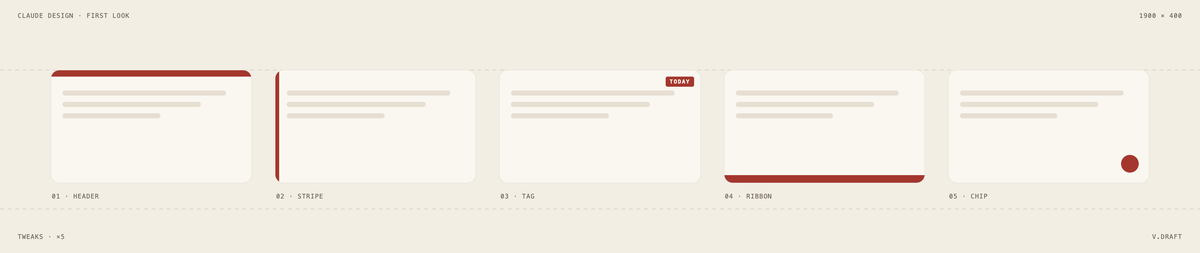
I've been playing with Claude Design since Friday. Everything I do runs through Claude Code and AI now. It's the cockpit. Billing, sales pipeline, content, code, calendar, all of it. So I ask the same first question with any new release. How does this extend what I can already do, or enable what I can't?
There's a second question this time, because when I talk to teams, designers have the most anxiety about what AI means for their future. And my early take is consistent with what I've seen in every other workflow AI has touched. It takes the grind off the plate. Whether that's good news for you depends on what your role actually was.
The grind goes away
If your design team's job is primarily implementing the design system across new pages and features, that work is going away. The churn, the production line, the "keep up with engineering" sword hanging over every designer's head. AI will handle that.
Hopefully that means room for the highest-leverage work. Investigating new patterns. Pushing the system forward. Doing the actual strategic design work that, in most companies, doesn't get the oxygen it needs.
I've watched this play out on many product development teams where design couldn't be a full part of the triumvirate because they were so busy keeping up with page production. The urgent crowded out the important. They never got to strategy, never got to vision, never got to be in the room when the product direction was set.
I recognize this pattern from my own life as a PM. There were stretches where I couldn't do my actual job, the strategy work, the vision work, because I was drowning in tickets and specs. At a senior level part of the job is solving exactly that problem, figuring out how to keep the motor running while also doing the long-term thinking. Hopefully AI helps more design teams navigate that shift.
The high-leverage funnels and workflows still need real designers. You don't hand those to the junior team member who just copies the buttons from elsewhere. But the grind work can go.
The risk is real, though. If your team still operates as a production line, that's going to be a problem. The larger problem is that many companies still don't understand or respect design, don't give it the room to do what it actually needs to do. AI is going to replace the haphazard way design gets used at those companies. It's on designers to reclaim the strategic seat.
What Claude Design actually does
When you fire it up, it pushes you to start from a design system. You can feed it a codebase, a doc, wherever your system lives, and it'll derive one for you. Even if your implementation has been haphazard, it constructs a coherent system from what exists. That part is cool.
Then it lets you apply that system to new things. A presentation. A doc. A new prototype. I pointed it at my website and at a mobile app I've been building and using, and the extraction step was genuinely impressive. The application step, taking that system and producing new artifacts in it, was even better.
Design is a visual medium and Claude Design defaults accordingly. Chat and code have developed clarification loops, asking questions before acting, but they still return one answer. Claude Design assumes design wants comparison, so it generates "tweaks," structured variations you can see side by side and pick from. I've done this in Claude Code by hand, asking for different mockup directions, spinning up a server to view them, building a little review flow. Claude Design bakes it in for people who wouldn't think to ask.
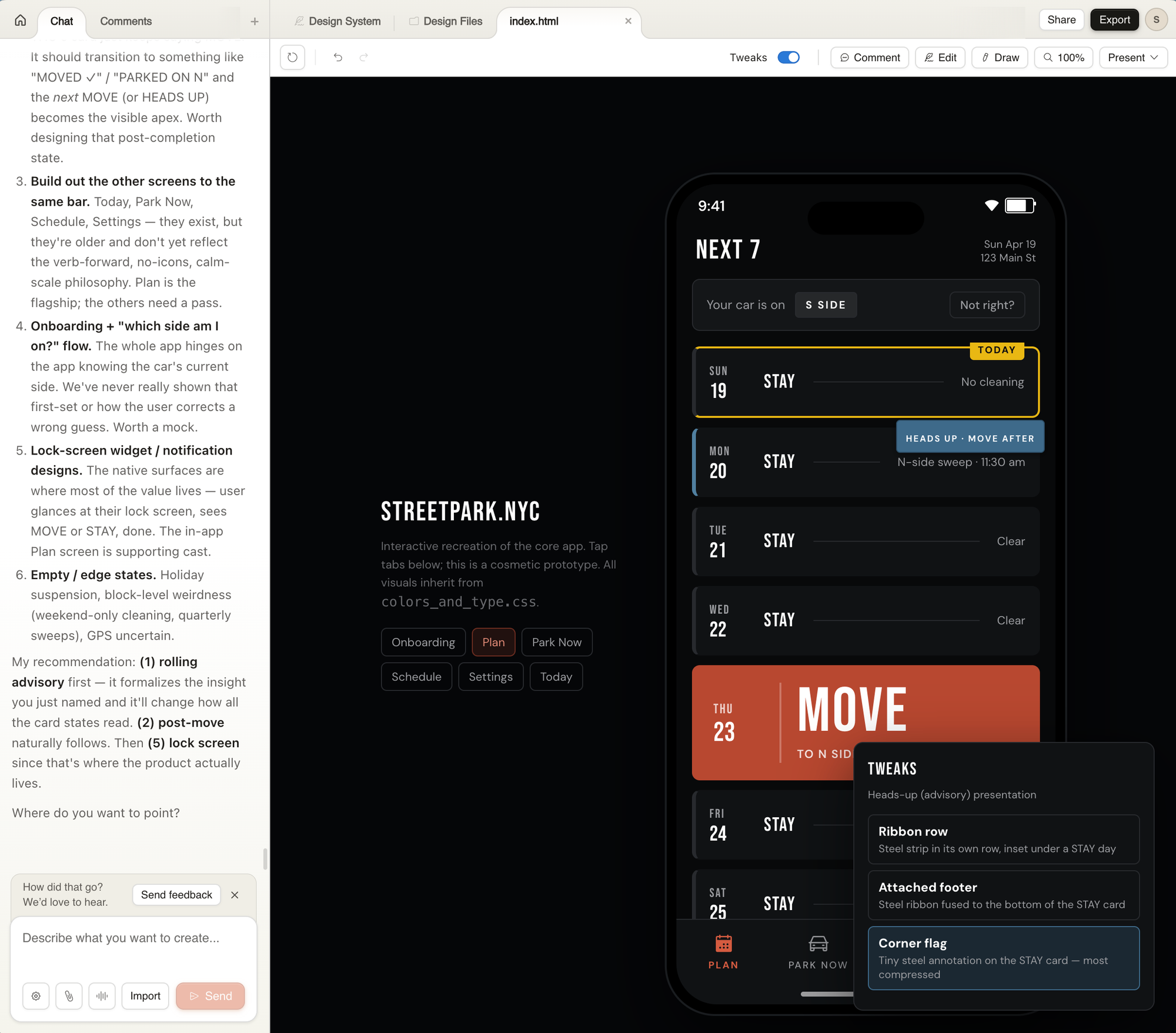
Navigating and creating the design itself is still a little clunky, the way Claude Code can be clunky in any domain if you lack the language to really engage it. But the core loop, derive a system, apply it consistently, is strong.
The design system is in context
The reason this works is that Claude Design has the whole design system scaffolded into its context, the same way Claude Code scaffolds in the whole codebase. I've been "designing" (air quotes) in Claude Code for a while and the results have been better than me-without-a-designer, but I will win no awards. Claude Design is different in kind, not degree.
I was working on an icon, something I hadn't figured out how to do cleanly in Claude Code. Claude Design knew the workflow. Mock it up in HTML first. Iterate until it's right. Then convert to SVG, then to the native iOS format. I could have done every step in Claude Code. I just hadn't thought out the individual pieces.
This reminds me of working with these tools 18 months ago. I wanted to create a contact file and I knew to tell Claude "create a VCF file." That one technical detail was the whole unlock, it connected all the dots for the model. Without it, the model wouldn't have gotten there.
Now the models are better, the harnesses are better, the tooling is better. Opus 4.7 inside a purpose-built harness connects those dots without me. I don't have to know to say "VCF." I don't have to know to say "mock the icon in HTML first." The tool is doing the thinking about the workflow. That's new.
Figma is cooked
I don't love making product category predictions. But this reinforces what's been clear for a while. No SaaS company is safe from the model labs. Can Figma ship AI-native workflows faster than Anthropic can redefine them? I doubt it. Figma has an existing customer base used to working a specific way, emotionally anxious about the transition, which means they'll be tempted to do both, maintain the old while building the new. Figma Make is a good attempt. I don't think it's enough.
It's like Excel. That used to be the tool for a range of workflows. Google Docs sliced off the bottom of that pyramid of work. Anyone making a checklist or who just wants to see some data can get that done. The lords of finance still live in Excel. The specialists will still appreciate and use Figma. But a host of people will find an easier path in something like Claude Design.
My own version of this. A while back I couldn't generate a decent LinkedIn cover image (models still can't do text well). So I built a webpage in Claude Code and screenshotted it. Then I automated the screenshot with Puppeteer, so the script resizes the browser, edits the HTML, takes the image. Now I use the same workflow for the little cards I publish with posts.
Is it design? Barely. It's image production in code. But the pattern generalizes. Spec documents become prototypes. Prototypes become the handoff. The PM team isn't shipping the prototype to production, they probably didn't even wire up the database. The value is that they can see and feel the experience, find the edge cases, surface the decisions that would've gotten lost in a spec. Then the engineering team reads that code as the spec and ports it into the real stack. Code as specification. Code as design.
It's still a capable intern
The longer I work with Claude Design, the more it fits the analogy I use for every other AI tool. It's a capable intern that doesn't know your business.
Senior designers I've worked with solve the problem for me. I don't get into the weeds. With Claude I do. I have to flag what it missed, name the feeling I'm going for, spell out what people should experience. Then it can apply. And it will get it right on the fourth or fifth attempt.
First version of my parking app in Claude Design came back with subtle gradients everywhere. I had to say, this is a parking app, I need at-a-glance clarity, not subtlety. Gradients speak subtlety. Ix-nay on the gradients.
It can do the work. It won't own the problem. You still have to bring the clarity yourself.
Caveat, it's a research preview
This is heavy on the research preview right now. I'm on the largest Anthropic plan (Max 20x) and I got usage-limited after a day and a half. It's not ready to be a production tool in your workflow yet.
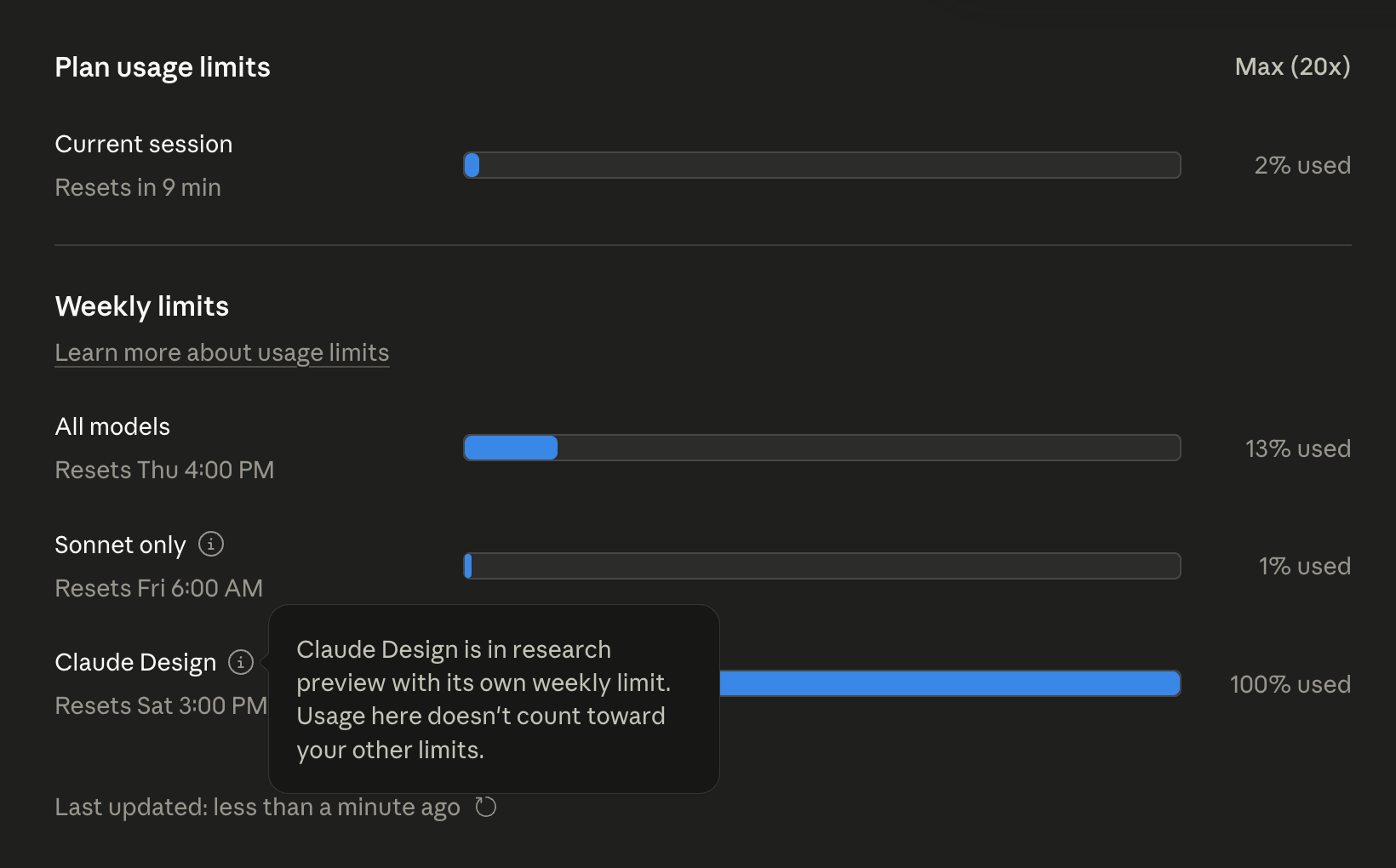
That said, try it. Take a side project through its paces. I used my parking app, something I'd already designed in Claude Code with items that were still bothering me. The value showed up fast.
I talked to a designer friend about it and the message was, your jobs are safe. But not all of them. The grind belongs to the robots now, same as it does for PMs and engineers.